
What Does It Really Take to Make Venezuela Investible?
A Technical Analysis by Nick Evans (MRICS) – Consultant, OGCS Global
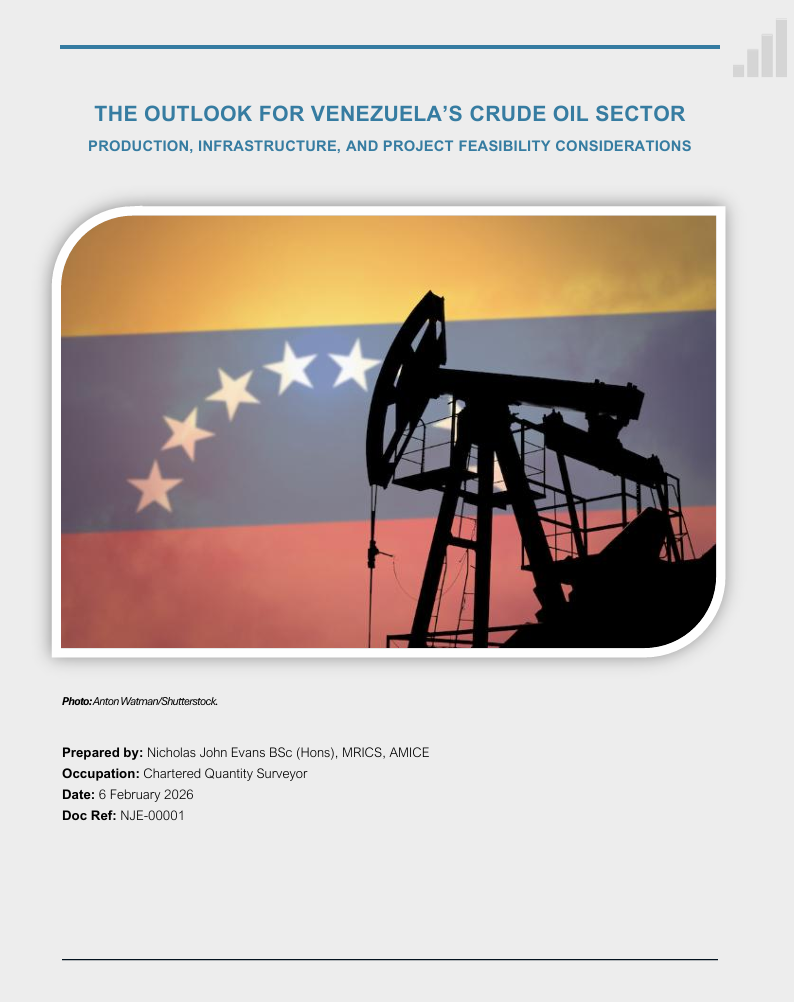
The Outlook for Venezuela’s Crude Oil Sector* by Nick Evans, MRICS, OGCS Consultant
Venezuela is home to the largest proven crude oil reserves in the world, yet it produces a fraction of its geological potential.
While headlines frame investment in Venezuela as unrealistic or unattractive, such assessments overlook the core technical and industrial realities that determine whether investment is truly feasible[1].
My report provides a high-level technical, infrastructure, and investment-focused assessment of Venezuela’s crude oil sector, with emphasis on production trends, core physical assets, and professional considerations relevant to potential rehabilitation and future capital investment.
A Technical, Not Geological, Challenge
The dominant narrative from industry professionals, including Petróleos de Venezuela, S.A. (PDVSA), echoes a central theme of my report: the challenge in Venezuela is less geological and more technical, requiring comprehensive planning, disciplined execution, and effective maintenance strategies to support a gradual and sustainable recovery of the industry.
PDVSA credited and re-shared this analysis via their official LinkedIn page stating:
“This study is technically solid and well structured, particularly in its distinction between resource size, installed capacity, and effective operational capability. We agree that the core challenge is not geological, but rather one of industrial execution, asset reliability, and the orderly reintegration of the value chain.”
This sentiment was also echoed in interaction with a current petroleum operations engineer at PDVSA:
“I agree that before considering nominal expansions, the most credible path is to restore the operational reliability of existing critical assets such as the Paraguaná Refining Complex… Investment and forecasting are impossible without a revalidation of field data such as the actual condition of wells, pipeline integrity, and auxiliary equipment.”
Breaking Down the Investment Debate
Many market observers have written off investment in Venezuela’s oil sector without fully accounting for on-the-ground conditions.
Asset Condition vs. Potential
Venezuela’s upstream, midstream, and downstream facilities have endured decades of underinvestment; refineries and pipelines often operate well below nameplate capacity. However, the report highlights clear potential and benefit in restoring activities across all level.
Regulatory and Contractual Clarity
Without clear, enforceable frameworks for contracts, ownership, and dispute resolution, investors (particularly major international oil companies) will remain cautious[2]. Following the recent changes announced on the 29th January 2026, Venezuela’s National Assembly approved a partial reform of the Organic Law of Hydrocarbons. This represents one of the most significant updates to the country’s oil and gas legal framework since the nationalization of the industry in 1976. The reform aims to allow greater operational and contractual flexibility, enabling the progressive recovery of capacities through increased participation by private investors. Collectively, these measures signal a decisive shift toward a more market-orientated sector.
Infrastructure Investment Timeline
Most independent energy analysts agree that meaningful gains in production will require a multi-year commitment. Simply restarting idle capacity won’t leapfrog Venezuela back to historic output levels; acceleration demands a disciplined and staged approach to project execution[3].
Capital investment will occur only after comprehensive technical validation and feasibility analysis has been carried out. Feasibility planning is essential to determine whether projects are technically, commercially, and legally viable. High-risk activities with the potential to drive cost overruns, schedule delays, or safety concerns must be carefully evaluated, while ensuring forecast financial returns justify investment.
Professional Engagement and Industry Feedback
Since publishing the report, professional engagement has been significant. Beyond the positive reception from PDVSA’s official channels, I have received numerous connection requests and direct messages from local industry experts affirming that the analysis accurately reflects Venezuela’s current infrastructure and investment feasibility across short, medium, and long-term horizons.
This corroboration from engineers and practitioners is not anecdotal. It highlights an essential point: investment attractiveness starts with credible technical assessment and validation among industry stakeholders.
Conclusion: Complexity Isn’t a Barrier — It’s a Parameter
Every project is inherently complex and bears its own unique risks. The question is how you deal with those risks and execute a project effectively.
Venezuela is neither perfect nor risk-free. But its issues can be systematically managed through disciplined engineering, data-driven assessment, and governance frameworks that satisfies investor risk profiling.
The oil reserves are real. The infrastructure degradation is real. However, the pathway to recover production, if undertaken with technical rigor and execution precision, is absolutely realistic.
Nick Evans is a Consultant at OGCS Global based in Houston, TX. Connect with Nick to learn how OGCS can support technical rigor and execution in your project.
FOOTNOTES
[1] https://resourcegovernance.org/publications/national-oil-company-profile-pdsva
[2] https://matrixbcg.com/products/pdvsa-pestle-analysis
[3] https://worldoil.com/news/2026/1/6/venezuela-oil-investment-faces-long-timelines-analysts-say
*The views expressed in Nick’s Energy Outlook Report are his own, and reflect his personal research, assessment and analysis.